1 · Inspect and clean
Use the machine’s approved procedure. Confirm tape path, heads, rollers, brakes and tension are in good condition.
 REEL ATLASTHE ART & SCIENCE OF TAPE
Good recordings begin before the red button.
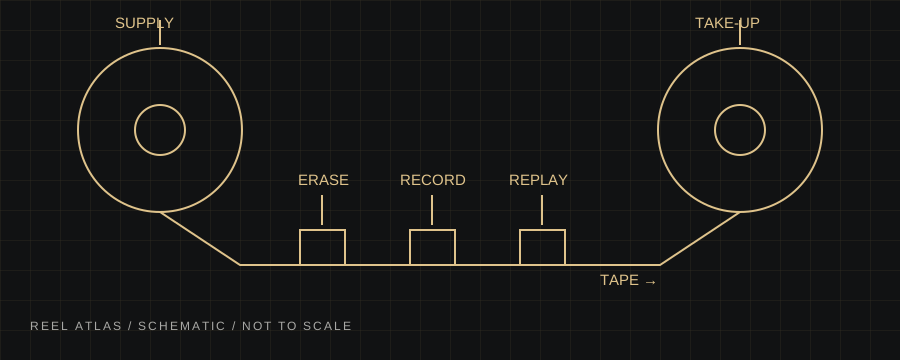
Use the machine’s approved procedure. Confirm tape path, heads, rollers, brakes and tension are in good condition.
A suitable calibration tape establishes replay level, azimuth and frequency response at the required speed and EQ.
Set bias, record sensitivity and record EQ for the actual tape formulation. Then check off-tape response, channel balance and distortion.
| Term | Meaning | Remember |
|---|---|---|
| Reference fluxivity · nWb/m | Magnetic reference recorded on tape | Examples include 185, 250, 320 and 510/514 nWb/m; identify the actual convention. |
| Line level · dBu / dBV | Electrical level at input or output | +4 dBu and −10 dBV are different nominal interfacing levels. |
| Meter level · VU / peak | Indication relative to machine alignment | 0 VU is not one universal magnetic level, and is not digital 0 dBFS. |
No. Tape saturation is frequency dependent. High-frequency peaks can distort before a slow VU meter makes the problem obvious. Monitor off tape and choose a level appropriate to programme and formulation.
A high-frequency signal added during analogue recording to improve linearity. Its optimum setting depends on the tape, speed and head system; it is not the playback EQ switch.
It describes a tape’s performance class relative to a stated reference under stated conditions. It is not an instruction to turn every recorder up by that number.
No. Protect it against accidental erasure. Use the correct speed, EQ, track arrangement and flux standard; follow its documentation.